Empire 1 The Stars, Like Dust by Isaac Asimov
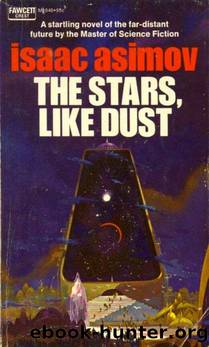
Author:Isaac Asimov [Asimov, Isaac]
Language: eng
Format: epub
Tags: General, Science Fiction, Imperialism, Adventure, Space colonies, Fiction
ISBN: 9780765319159
Publisher: Tom Doherty Associates
Published: 2009-09-29T04:00:00+00:00
TWELVE:
The Autarch Comes
The Autarch of Lingane pondered the matter, but his cool, well-trained features scarcely creased under the impact of thought.
âAnd you waited forty-eight hours to tell me,â he said.
Rizzett said boldly, âThere was no reason to tell you earlier. If we bombarded you with all matters, life would be a burden to you. We tell you now because we still make nothing of it. It is queer, and in our position we can afford nothing queer.â
âRepeat this business. Let me hear it again.â
The Autarch threw a leg upon the flaring window sill and looked outward thoughtfully. The window itself represented perhaps the greatest single oddity of Linganian architecture. It was moderate in size and set at the end of a five-foot recess that narrowed gently toward it. It was extremely clear, immensely thick, and precisely curved; not so much a window as a lens, funneling the light inward from all directions, so that, looking outward, one eyed a miniature panorama.
From any window in the Autarchâs Manor a sweep of vision embracing half the horizon from zenith to nadir could be seen. At the edges there was increasing minuteness and distortion, but that itself lent a certain flavor to what one saw: the tiny flattened motions of the city; the creeping, curved orbits of the crescent-shaped stratospherics climbing from the airport. One grew so used to it that unhinging the window to allow the flat tameness of reality to enter would seem unnatural. When the position of the sun made the lenslike windows a focus for impossible heat and light, they were blanked out automatically, rather than opened, rendered opaque by a shift in the polarization characteristics of the glass.
And certainly the theory that a planetâs architecture is the reflection of a planetâs place in the Galaxy would seem to be borne out by the case of Lingane and its windows.
Like the windows, Lingane was small yet commanded a panoramic view. It was a âplanet stateâ in a Galaxy, which, at the time, had passed beyond that stage of economic and political development. Where most political units were con. glomerations of stellar systems, Lingane remained what it had been for centuries--a single inhabited world. This did not prevent it from being wealthy. In fact, it was almost inconceivable that Lingane could be anything else.
It is difficult to tell in advance when a world is so located that many Jump routes may use it as a pivotal intermediate point; or even must use it in the interests of optimal economy. A great deal depends on the pattern of development of that region of space. There is the question of the distribution of the naturally habitable planets; the order in which they are colonized and developed; the types of economy they possess.
Lingane discovered its own values early, which was the great turning point of its history. Next to the actual possession of a strategic position, the capacity to appreciate and exploit that position is most important. Lingane had proceeded to occupy small
Download
This site does not store any files on its server. We only index and link to content provided by other sites. Please contact the content providers to delete copyright contents if any and email us, we'll remove relevant links or contents immediately.
Personalized inhaled bacteriophage therapy for treatment of multidrug-resistant Pseudomonas aeruginosa in cystic fibrosis by unknow(174995)
CONSORT 2025 statement: updated guideline for reporting randomized trials by unknow(83363)
Critical evaluation of the ProfiLER-02 study design and outcomes by Vivek Subbiah & Razelle Kurzrock(83060)
Cardiac gene therapy makes a comeback by Oliver J. Müller & Susanne Hille & Anca Kliesow Remes(82889)
Whisky: Malt Whiskies of Scotland (Collins Little Books) by dominic roskrow(74436)
Unveiling the design rules for tunable emission in graphene quantum dots: A high-throughput TDDFT and machine learning perspective by Şener Özönder & Mustafa Coşkun Özdemir & Caner Ünlü(50892)
A yeast-based oral therapeutic delivers immune checkpoint inhibitors to reduce intestinal tumor burden by unknow(40259)
Covalent hitchhikers guide proteins to the nucleus by Alexander F. Russell & Madeline F. Currie & Champak Chatterjee(40215)
Meet the Authors: Christopher R. Mansfield and Emily R. Derbyshire by Christopher R. Mansfield & Emily R. Derbyshire(40094)
Alkaline-earth metals promote propane dehydrogenation with carbon dioxide through geometric effects: Altering the reaction pathway by unknow(32730)
Induced iron vacancies boosting FeOOH loaded on sustainable Fenton-like collagen fiber membrane for efficient removal of emerging contaminants by unknow(32504)
Efficient electric-field-assisted photochemical conversion of methane to n-propanol exclusively over penetrated TiO2Ti hollow fibers by Guanghui Feng(32452)
Bi2SiO5 nanosheets as piezo-photocatalyst for efficient degradation of 2,4-Dichlorophenol by Hangyu Shi & Yifu Li & Lishan Zhang & Guoguan Liu & Qian Zhang & Xuan Ru & Shan Zhong(32384)
A novel NDIPTA organic heterojunction photocatalyst with built-in electric field for efficient hydrogen production by Jiahui Yang & Baojun Ma & Yongfa Zhu(32360)
Enhanced conversion of methane to liquid-phase oxygenates via hollow ferrite nanotube@horseradish peroxidase based photoenzymatic catalysis by Jun Duan & Shiying Fan & Xinyong Li & Shaomin Liu(32330)
Ordered macroporous superstructure of defective carbon adorned with tiny cobalt sulfide for selective electrocatalytic hydrogenation of cinnamaldehyde by Xiao-Shi Yuan & Sheng-Hua Zhou & San-Mei Wang & Wenbo Wei & Xiaofang Li & Xin-Tao Wu & Qi-Long Zhu(32256)
What's Done in Darkness by Kayla Perrin(27144)
Topological analysis of non-conjugated ethylene oxide cored dendrimers decorated with tetraphenylethylene: Insights from degree-based descriptors using the polynomial approach by A Theertha Nair & D Antony Xavier & Annmaria Baby & S Akhila(26522)
Investigation of mechanical and self-healing properties of hydroxyl-terminated polybutadiene functionalized with 2-ureido-4-pyrimidinone by Mohsen Kazazi & Mehran Hayaty & Ali Mousaviazar(26457)
